Affiliate marketing works. Industry benchmarks consistently put its share of global ecommerce orders in the mid-teens percentage range, and most of that runs through independent stores, not marketplaces. If you sell on Shopify and haven’t opened an affiliate channel, you’re leaving a distribution channel unused that costs nothing until it produces a sale.
| 5-20% | RM 0-860/mo (USD 0-199) | Under 1 day |
| Typical commission range Malaysian Shopify sellers offer, by margin | Starting-tier price range across UpPromote, Refersion, and LeadDyno, per each provider’s official pricing page, August 2026 (month-to-month rates) | Time to install an affiliate app and list your first product |
What Is a Shopify Affiliate Program and How Does It Work?
A Shopify affiliate program is a system that pays external partners — creators, bloggers, or other sellers — a commission for every sale they refer to your store. It runs through a tracking app installed on your Shopify admin, which generates a unique link or discount code per affiliate, attributes the sale, and calculates the payout automatically.
The mechanics are simple. An affiliate signs up, gets a unique referral link (and often a discount code), and shares it with their audience. When a shopper clicks the link and buys within a set cookie window — usually 30 days — the app logs the sale against that affiliate and calculates their commission based on the rate you set.
Unlike paid ads, you don’t pay for clicks or impressions. You pay only when a sale closes, which makes affiliate programs one of the few purely performance-based channels available to Shopify sellers. The tradeoff is setup time and ongoing relationship management: an affiliate program with no active affiliates produces nothing.
For Malaysian sellers running Shopify alongside Shopee MY or Lazada MY, an affiliate program is also the only easy way to build a direct-to-consumer distribution channel that doesn’t depend on marketplace algorithms or ad auctions.
Which Shopify Affiliate App Should You Use?
Shopify’s App Store lists dozens of affiliate and referral tools, but most Malaysian sellers narrow the choice to three or four: UpPromote (free forever tier, budget-friendly), Refersion (free marketplace listing only, paid tiers for full tracking), Shopify Collabs (Shopify’s own native tool, free with a Shopify plan), and LeadDyno (flexible payout options, no free plan). Pick based on your budget and how much manual review you want over affiliate applications.
| App | Starting Price | Free Plan | Best For |
|---|---|---|---|
| Shopify Collabs | Free with Shopify plan | Yes | Sellers who want a native tool with no extra app fee |
| UpPromote | Free forever; paid from $29.99/mo (~RM 130) + 2% performance fee | Yes | New programs testing affiliate marketing on a tight budget |
| Refersion | Marketplace listing free; full tracking from $39/mo (~RM 169) + 3% commission, or $199/mo (~RM 860) for advanced features | Listing only | Stores that need advanced commission options and multi-store management |
| LeadDyno | From $49/mo (~RM 211), covers up to 50 active affiliates | No | Sellers who want flexible payout methods, including PayPal and store credit |
Pricing verified against each provider’s official pricing page in August 2026, using standard month-to-month rates (annual billing lowers Refersion and LeadDyno’s effective monthly cost by roughly 15-20%). All three charge in USD; RM figures are approximate conversions. SaaS pricing changes often, so confirm current rates before committing — most also add a performance fee or commission on top of the base subscription.
Shopify Collabs is the obvious starting point for most Malaysian sellers because it’s built by Shopify, requires no separate subscription, and connects directly to your product catalogue and order data. It’s lighter on advanced features — no multi-tier commissions, limited fraud detection — but for a first affiliate program, that simplicity is a feature, not a limitation.
Move to a dedicated app like UpPromote or Refersion once you’re managing more than 15-20 affiliates, need custom commission tiers by product or affiliate performance, or want deeper fraud protection against self-referral abuse.
How Do You Set Up an Affiliate Program on Shopify?
Setup takes four steps: install an affiliate app from the Shopify App Store, connect it to your product catalogue, set your commission structure, and publish an application page for affiliates to sign up. Most Malaysian sellers complete initial setup in under a day, though building a working affiliate roster takes longer.
Step 1: Install your chosen app
From your Shopify admin, go to Apps → Shopify App Store, search for your chosen tool, and click Add app. Shopify Collabs installs as a native Shopify feature under Marketing; third-party apps like UpPromote or Refersion install like any other Shopify app and prompt you through initial configuration.
Step 2: Connect your product catalogue
Choose which products are eligible for affiliate commission. Most sellers start with their full catalogue, then exclude low-margin or clearance items where a commission payout would erase the profit.
Step 3: Set your commission structure
Decide on a flat rate (e.g., 15% on every sale) or tiered rates by product category or affiliate performance. Keep it simple at launch — a single flat rate is easier for affiliates to understand and easier for you to manage.
Step 4: Build your affiliate application page
Most apps generate a public application page automatically. Add your commission rate, cookie window, and a short pitch on why creators should promote your store. Link this page from your site footer or an “Affiliates” navigation item so interested creators can find it without you reaching out first.
What Commission Rate Should You Offer Shopify Affiliates in Malaysia?
Most Malaysian Shopify sellers offer 5-20% commission, scaled to product margin. Low-margin categories like electronics and groceries typically sit at 5-10%; higher-margin categories like beauty, supplements, and apparel commonly run 15-25%. The rate needs to beat what affiliates could earn promoting a competing store in your category.
Commission rate is the single lever that determines whether creators bother applying to your program. Set it too low, and experienced affiliates skip your listing for a competitor’s. Set it too high on thin-margin products, and every affiliate sale loses money after fulfillment and payment processing costs.
A practical starting point: calculate your gross margin per product, then offer 30-50% of that margin as commission. A product with 40% margin can typically support a 12-20% commission rate and remain profitable after ad-equivalent cost comparisons.
Consider a tiered structure once you have data: a base rate for new affiliates, with a bump (2-5 percentage points) for affiliates who cross a monthly sales threshold. This rewards your best performers without raising costs on affiliates who generate little volume.
How Do You Recruit Affiliates for Your Shopify Store?
Recruitment works through three channels: your existing customer base (turn repeat buyers into affiliates), direct outreach to creators in your niche, and affiliate marketplaces built into apps like UpPromote and Refersion where creators browse open programs. Most Malaysian sellers start with customers first — they already know and trust the product.
Start with your customer list. Email past buyers with a simple pitch: “Loved your order? Earn [X]% for every friend you refer.” Existing customers convert into affiliates at a far higher rate than cold outreach because they’ve already used the product.
Reach out to niche creators directly. Search Instagram and TikTok for creators posting about your product category in Malaysia. A short, specific message — referencing their actual content, not a generic template — gets a far higher response rate than mass outreach.
List your program in app marketplaces. UpPromote, Refersion, and similar tools include a directory where creators actively looking for affiliate programs can find and apply to yours without you reaching out. This is the lowest-effort recruitment channel once your program is live.
Keep the application process short. A form asking for a name, email, and social handle converts better than one demanding a full media kit — you can always vet further after initial signup.
How Do You Track and Pay Shopify Affiliate Commissions?
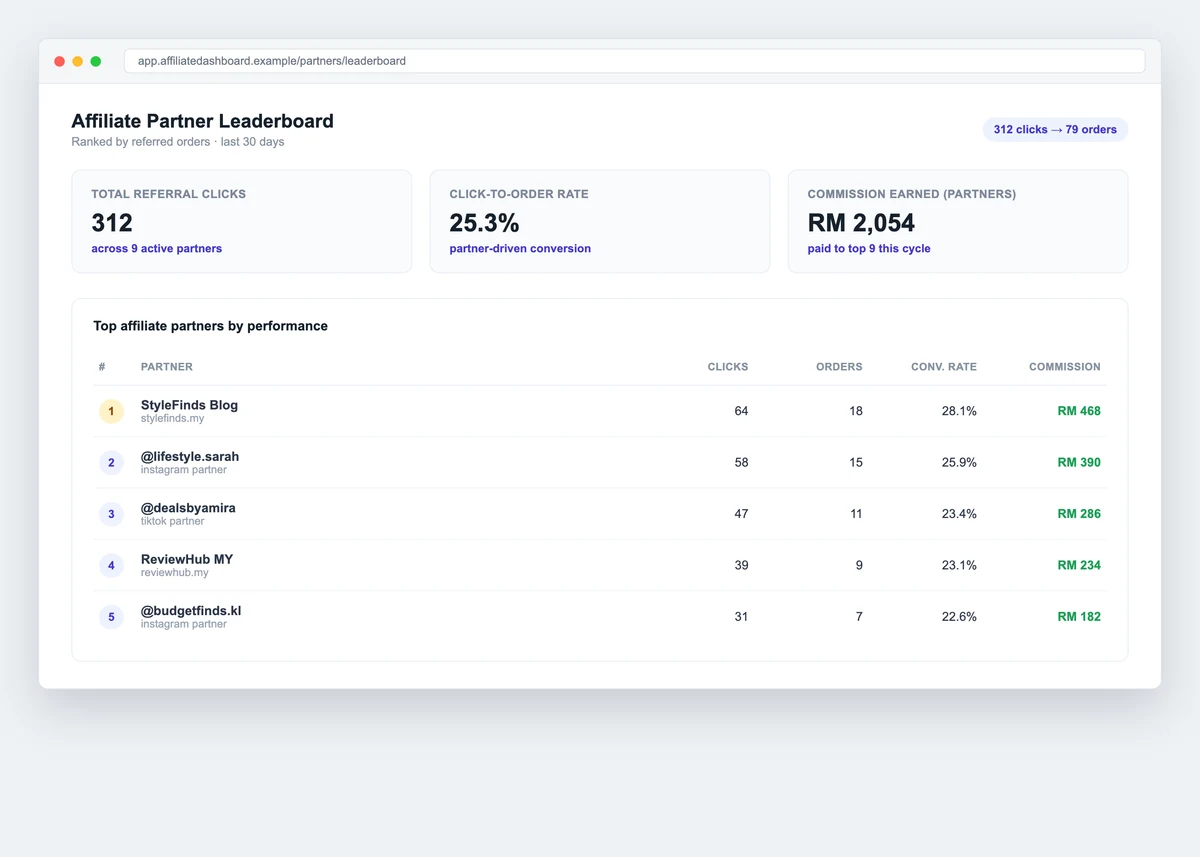
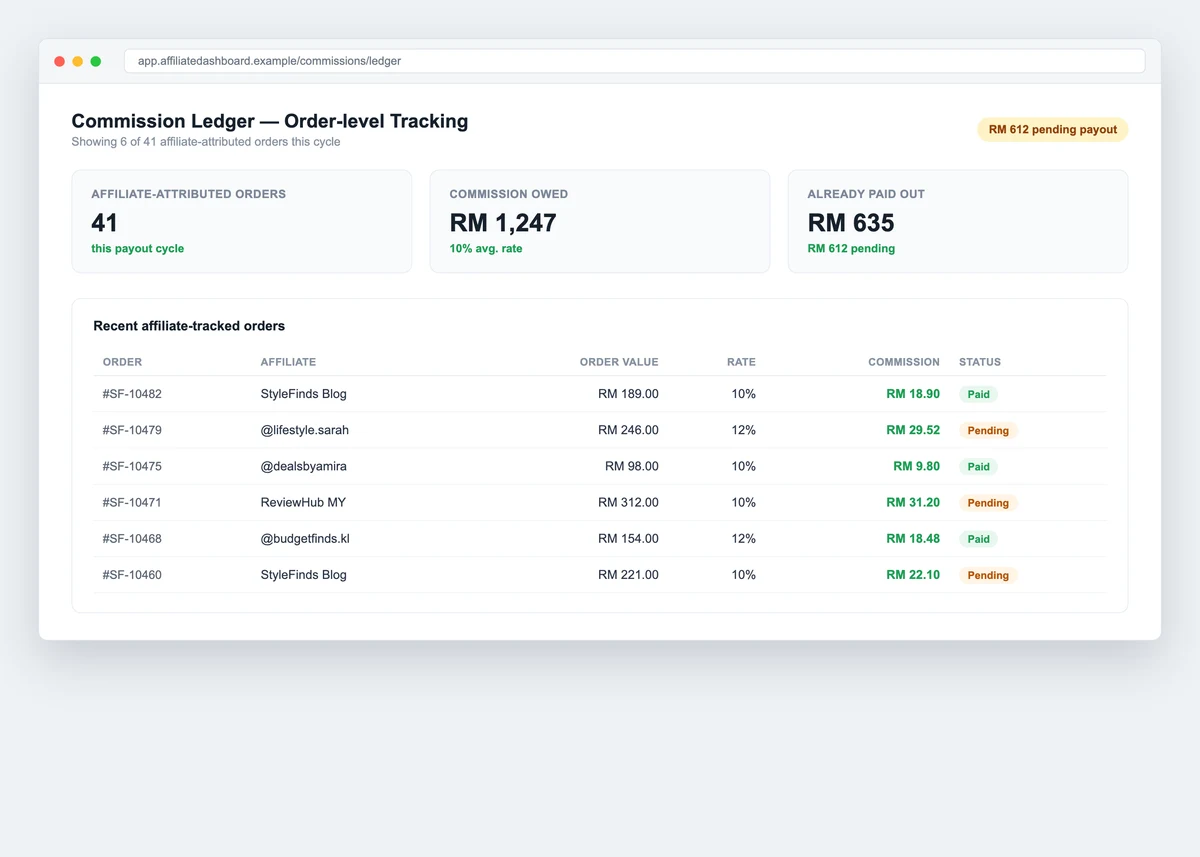
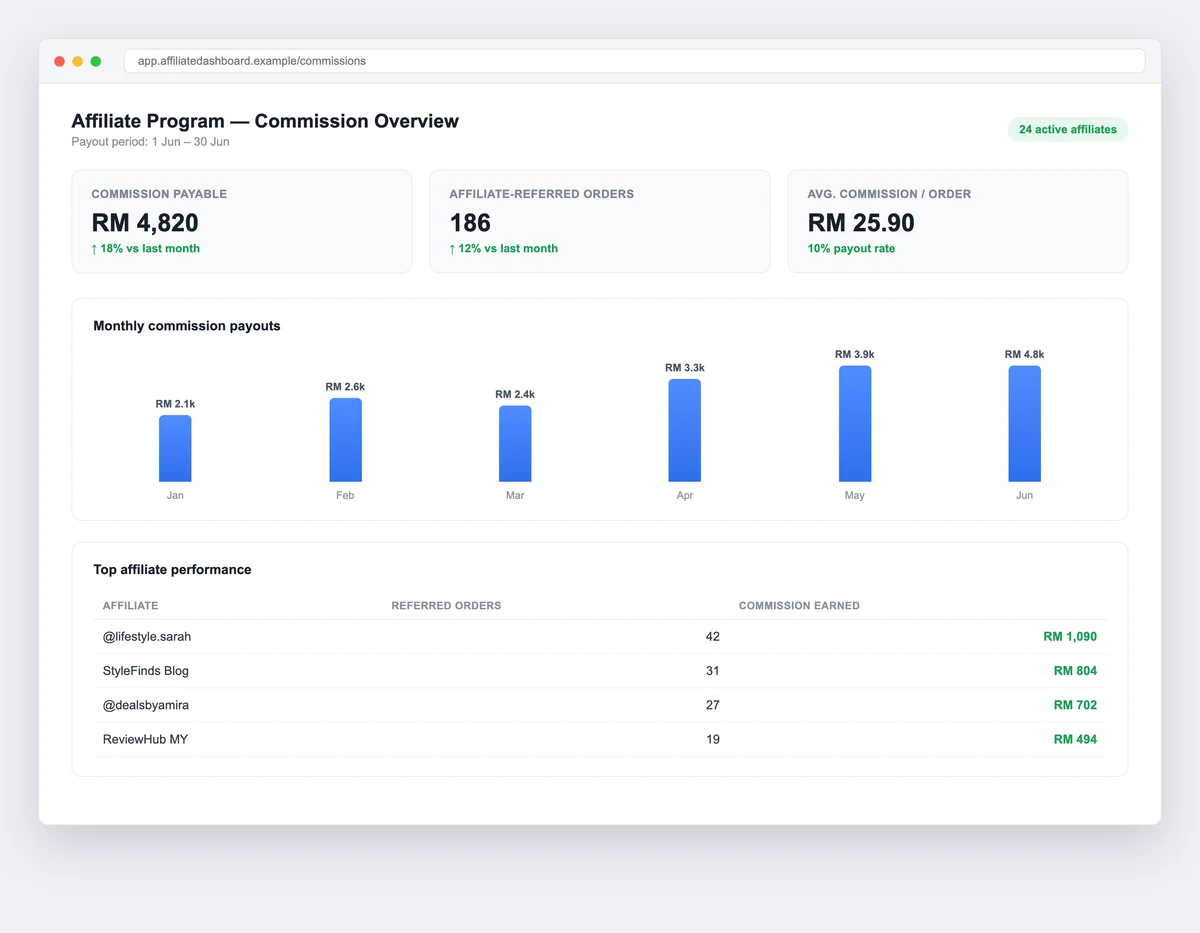
Affiliate apps track sales automatically through unique links, discount codes, or both, then calculate commission owed per affiliate in a dashboard. Payout typically happens monthly, either automated through the app (PayPal, bank transfer) or manually once you export the commission report.
Every major Shopify affiliate app generates a payout report showing commission owed per affiliate for the period. Some, like LeadDyno, support automated payouts directly through PayPal. Others require you to export the report and process payments manually through your bank.
Set a clear payout schedule (monthly is standard) and a minimum payout threshold (e.g., RM 50) to avoid processing tiny payments that cost more in transaction fees than they’re worth. Communicate both clearly on your affiliate application page so there’s no confusion once affiliates start generating sales.
A Shopify affiliate program is one distribution channel among several. It pairs naturally with the email flows covered in our Shopify email marketing setup guide — welcome affiliates the same way you welcome new subscribers, with a clear first action. For sellers also running TikTok Shop, the mechanics differ enough that it’s worth reading our TikTok Shop affiliate marketing guide separately, since that program runs entirely inside TikTok’s own tracking system.
Frequently Asked Questions
How much does it cost to run a Shopify affiliate program?
Entry-tier Shopify affiliate apps run free to roughly RM 130-860 a month (about USD 30-199), per UpPromote, Refersion, and LeadDyno’s official pricing pages as of August 2026, using standard month-to-month rates. UpPromote offers a free-forever plan for small stores, and Refersion offers a free marketplace-listing tier with no tracking. Most paid tiers also add a small performance fee (1-3%) on top of the subscription, charged only on sales an affiliate actually generates.
What commission rate should Malaysian Shopify sellers offer affiliates?
Typically 5-20% of order value, depending on margin. Low-margin categories (electronics, groceries) sit near 5-10%; higher-margin categories (beauty, supplements, apparel) commonly offer 15-25%. Set the rate high enough to beat what affiliates earn promoting competing stores in your category.
Do I need a Shopify affiliate app, or can I track affiliates manually?
A dedicated app is worth it past your first few affiliates. Manual tracking with discount codes works for 2-3 partners, but breaks down fast: no automated payouts, no fraud checks, and no dashboard for affiliates to see their own performance. Apps like UpPromote, Refersion, and Shopify Collabs automate link tracking, commission calculation, and payout.
How is a Shopify affiliate program different from a TikTok Shop affiliate program?
A Shopify affiliate program runs on your own store and lets affiliates promote any product with a tracked link, cookie, or discount code, paid however you choose (bank transfer, PayPal, store credit). TikTok Shop’s affiliate system is built into that one platform, pays through TikTok Shop directly, and only tracks sales made inside the TikTok Shop app.
Can I run a Shopify affiliate program alongside my Shopee or Lazada store?
Yes. Your Shopify affiliate program only tracks sales made on your Shopify storefront. Shopee and Lazada each have separate seller-tools for creator commissions inside their own marketplaces, so most Malaysian sellers running both channels manage two affiliate systems in parallel, not one combined program.